Every stainless or carbon steel part starts life in a single melt at the mill. The heat number is the ID of that melt, and it is the only thing that links the part in your hand to the test results on a certificate.
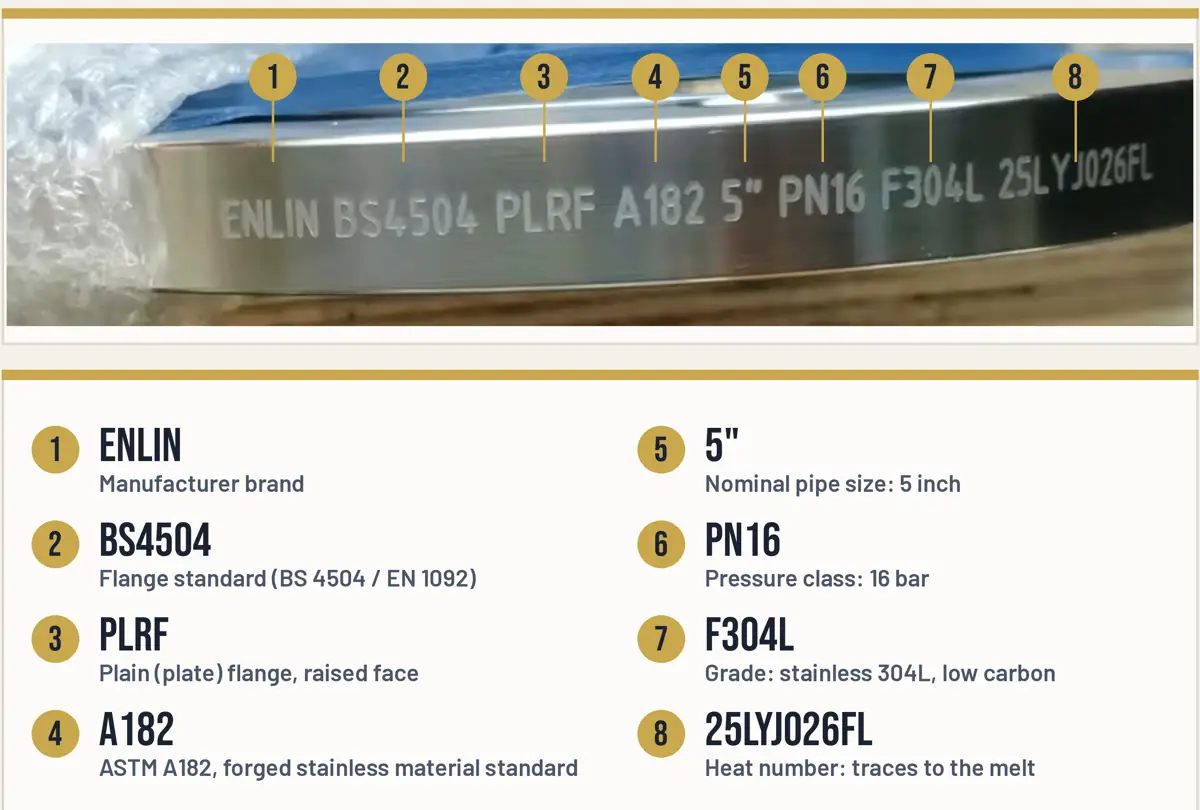
What a heat number is
Steel is made in batches called heats. The mill tests each heat for chemical composition and mechanical properties, then records the results against the heat number. Every product made from that steel, whether it is a flange, a valve body or a butt-weld elbow, should carry that number or a code that traces back to it.
Without a heat number on the part, a certificate is just a piece of paper. It might be genuine, but nothing proves it belongs to your item.
Where to find it on the part
- Flanges: stamped or laser-etched on the rim, usually alongside the brand, standard, size, rating and grade. For example: ENLIN BS4504 PLRF A182 5" PN16 F304L 25LYJ026FL, where the last code is the heat number.
- Cast valves: cast into the body or stamped near the body markings, and often repeated on a riveted nameplate on the bonnet or cover.
- Butt-weld fittings: stencilled or stamped on the outside surface, with size, schedule and grade.
Know which certificate you are getting
EN 10204 defines four types of inspection document. They are not equal:
| Type | What it says | What it proves |
|---|---|---|
| 2.1 | Declaration that the product complies with the order | No test results at all |
| 2.2 | Test results from routine production | Typical results, not from your product |
| 3.1 | Results of tests on the delivered product or its heat | Validated by the manufacturer's authorised inspector, independent of production |
| 3.2 | As 3.1, also signed by the buyer's or a third-party inspector | Independent witness of the testing |
For most industrial piping, a 3.1 certificate is the document to ask for.
Three checks before you accept the part
- Match the heat number. The number on the certificate must match the number on the part. If it doesn't, the certificate tells you nothing about that part.
- Match the product and standard. The certificate should name the same product form, size and specification as the marking, for example ASTM A182 F304L for a forged stainless flange or ASTM A351 CF8M for a cast stainless valve body.
- Read the results against the standard. Chemistry (carbon, chromium, nickel and, for 316 grades, molybdenum) should fall within the standard's limits, and the tensile, yield and elongation values should meet its minimums.
Red flags
- No heat number anywhere on the part.
- One certificate offered for several different grades or sizes.
- A photocopy where the heat number looks altered or handwritten.
- Results labelled "typical" on a document sold as a 3.1.
- No inspector's signature, stamp or certificate number.
How we handle it at Al Juyushi
Our stock is grade-verified before it goes on the shelf and marked for traceability. The heat or batch number is recorded, and an EN 10204 3.1 certificate is available on request for the heat you buy.